Business
Zenith Bank’s Winning Streak: How They’re Dominating the Market

Zenith Bank’s Winning Streak: How They’re Dominating the Market
Since January 2, Zenith Bank’s share price has steadily increased from N64.50 to surpass the N100 mark by March 16. This remarkable market rally reflects a positive trajectory, and it’s understandable that such growth brings excitement and hope to many investors.
What we are seeing is the culmination of informed consensus that the share price did not reflect the latent value.
Starting from October, when the stock traded in the high sixties, analysts at leading firms begun revising their forward fair value estimates with projections ranging from N87 to N118.9.
This signalled a recalibration of what they judged as a reasonable long-term target for the shares.
Their model-driven conviction was seen in recommendations that shifted from cautious Hold and Peer Perform ratings to Buy, Outperform, and Overweight.
Typical was a January report by Renaissance Capital Africa titled “Substance over Form” presenting projections for the five FUGAZ banks.
Olumide Sole, the research firm’s head of financial institutions research observed that following regulator-imposed loan write-offs at the end of June last year, Zenith Bank’s balance sheet emerged strengthened. As a consequence, RenCap increased its Target Price (TP) by 96 per cent to ₦107.97.
Timothy Wambu, head of equity research at Absa Bank Kenya, gave Zenith a resounding Overweight recommendation in a December 2025 report dissecting the prospects for the top Nigerian banks namely Access Holdings PLC, Guaranty Trust Holdings PLC, Stanbic IBTC Holdings PLC, UBA PLC and Zenith Bank.
Defending his decision, the analyst wrote “Zenith screens as inexpensive.”
Using the Gordon Growth Model (GGM), a dividend discount model popular for determining a stock’s intrinsic value based on a constant, perpetual growth rate of dividends, Wambu estimated that Zenith Bank’s shares were undervalued at 0.5x of its price-to-book ratio. In other words, the stock was trading at 50 per cent of its net asset value. This left sizeable headroom for value investors to hop on board for the upswing.
Given the share price of N62.67 at the beginning of December, he projected a potential upside of 61 per cent, leading him to raise his 3-month price target to N96.84 with a best-case scenario 12-month target price of N131.00, that is, by the end of 2026.
Second anniversary present
When she was announced as the group managing director of Zenith Bank in March 2024, not a few outsiders were surprised.
After all, Dame (Dr.) Adaora Umeoji had returned to the financial institution, where she built her entire career before taking a leave, less than a year ago.
In the early noughties, she established a formidable reputation as a star marketer who pulled in big ticket accounts. Her rainmaker skills extended to cultivating relationships at the highest levels of Corporate Nigeria.
She stepped into her new role without missing a beat.
Since then, the soft-spoken fair-skinned banker who rose through the ranks at Zenith, has stamped her strategic vision and execution model on Nigeria’s second-largest bank by market value.
A senior banker at another institution who has known her for over two decades described the GMD’s leadership style as “disciplined and decisive”.
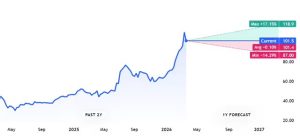

Analyst price target range for Zenith Bank PLC
Her decision to exit the Central Bank of Nigeria’s regulatory forbearance within two weeks after the regulator issued commercial banks a directive to that effect was evidence that she had zero tolerance for ambiguity.
It was not a tiny pill to swallow. Zenith Bank reclassified N1.4 trillion of loans from Stage 2 to Stage 3, then wrote off N1.2 trillion in one swell swoop.
The reasoning within the bank was that what had to be done should be done, and done quickly. The market nodded in silent approval.
Reinforced by an experienced board and a deep bench of executive talent, Umeoji has been smashing records back-to-back.
The significance of International Women’s Day and Women’s History Month being celebrated in the same month that Zenith Bank’s stock breeched N100 for the first time since it was listed twenty-two years ago is not lost either.
Showing doings
Share prices move for a multitude of reasons. Recently, NGX Regulation Ltd. lifted a one-month trading suspension on a stock, which recorded a 772 per cent gain to ₦17.36.
The regulator had imposed a freeze in trading after the company, which listed its shares at N1.81 on January 20, saw a vertiginous price climb that raised eyebrows.
In the end, no foul play was discovered. Some market commentators put it down to inexplicable animal spirits, and trading exuberance.
In Zenith Bank’s case the share price gain stands on terra firma.
Asides the expectation that the bank, supported by the balance sheet clean-up of forbearance and single obligor limit exposures, would increase its dividend payout ratio there were other tailwinds pushing it forward.
Other factors include its capacity to anticipate and absorb regulatory action, deploy its balance sheet efficiently, accelerate technology transitions, accelerate technology transition, boost channel optimisation, and seize opportunities in generative AI particularly in customer support, front office functions, and hyper-personalisation of customer offerings.
If further proof of market confidence was required, the keen appetite for Zenith Bank shares displayed by investors during its capital raising last year put the matter to rest. In a crowded fundraising market, it was one of the first two banks to cross the recapitalisation finish line.
In total, the bank raised NN350.4 billion through Rights Issue and Public Offer.
Fortified by dry gunpowder, the financial institution will maintain pole position through scale advantage, which has transformed from a defensive moat into an offensive weapon.
All said, Zenith Bank’s Goliath Premium is here to stay.
Putting the capital to work
Nigerian banks have entered a new era.
Among the Tier 1 banks competition will get even stiffer. The easy money has been made. Upbound surprises on the league tables are going to get harder as incumbents defend their turf tenaciously. Under these circumstances, capital will confer competitive advantages.
An investment bank analyst put it this way.
“Beyond its impressive financial metrics, Zenith Bank’s performance in the last 12 months speaks to its capacity for high intensity strategic execution across multiple initiatives. Fueled by new capital, investors are waiting to see how it will reshape the banking landscape.”
Zenith Bank has long been regarded as one of Nigeria’s most reliable income stocks. This reputation continues to underpin investor appeal.
For many shareholders, Zenith is a vehicle for dependable dividends, capital returns and exposure to an internationally diversified banking franchise known for expense efficiencies and non-negotiable compliance and control priorities.
Planting the flag
Historically, Zenith Bank has proceeded on international expansion with less haste than some of its Tier 1 peers.
Possibly a reflection of Jim Ovia, its founder’s extensive wargaming approach before committing to big leaps, Zenith is known for rigorous simulation and scenario planning.
Ovia’s aversion to grafting scions onto rootstock through M&A to buy growth is well known.
The computer science graduate who Forbes magazine christened the “Godfather of Nigerian banking” is also known for his distaste for lateral hires into the senior cadres of the bank.
“Catch ‘em young, grow ‘em tall,” is his operating mantra.
He is essentially a nurturer who insists on patient development from greenhouse to garden.
However, under Umeoji the bank is determined to paint the map red.
In keeping with Ovia’s philosophy, Zenith Bank is going the organic route. Investors do not expect to hear of any acquisition plans of existing banks abroad.
This month it commissioned a new branch in Manchester, a first for a Nigerian bank in the UK’s second largest city. Manchester joins Dubai, London, Paris and Beijing in expanding Zenith Bank’s footprint outside Africa.
On the continent, the bank currently has branches in Accra, Banjul, and Freetown. New ones are planned for Abidjan, Yaounde, and Nairobi in 2026 to build out its franchise in SSA’s fastest growing economies.
In their best interest
Closely tied to international expansion, Zenith Bank has been proactive in shadowing its customers every transaction of the way.
This explains the decision of Ebenezer Onyeagwu, Umeoji’s predecessor to get on the African cross-border payments train as far back as 2022 when other Nigerian banks were skeptical about its feasibility.
In that year, Zenith Bank signed an MoU with the African Continental Free Trade Area (AfCFTA)Secretariat to develop Smart AfCFTA, a complimentary digital trade promotion platform for the Pan African Payment and Settlement System (PAPSS).
Since then, the commercial bank has moved aggressively to establish its leadership in handling payments processing for intra-African transactions.
Refuge in economic anxiety and market volatility
What no one predicted was that a blistering war would break out in the Middle East between the US and Isreal against Iran.
The war in the Persian Gulf is having unintended consequences around the world.
Closure of the Strait of Hormuz, stranded oil and LNG shipments in the Gulf, disrupted supply chains, blocked fertilizer orders, inflationary pressures on import-dependent countries like Nigeria, spiking yields in international bond markets, hikes in insurance premiums for shipping, are just a few of the fallouts of the conflict.
Economists and geopolitical experts have been warning that there are more unknown unknowns ahead.
Coming at a time the Nigeria economy is turning the bend, the war could undo significant progress made in the Tinubu administration’s structural reforms.
Expectedly, investors are on the prowl for defensive assets that can blunt the impact of tetchy markets, while retaining their potential to rebound quickly in a recovering up market.
In this environment of geopolitical turmoil, Zenith Bank stands out as a macro-economic force multiplier that will play a key part in President Tinubu’s ambition to raise the country’s GDP to $1 trillion by 2030.
It is not farfetched to state that Zenith Bank shares are among a handful of fortress stocks on the NGX that offer investors an impregnable defensive value buffer zone.
Shall we say then that all things are working together for Zenith Bank’s good?